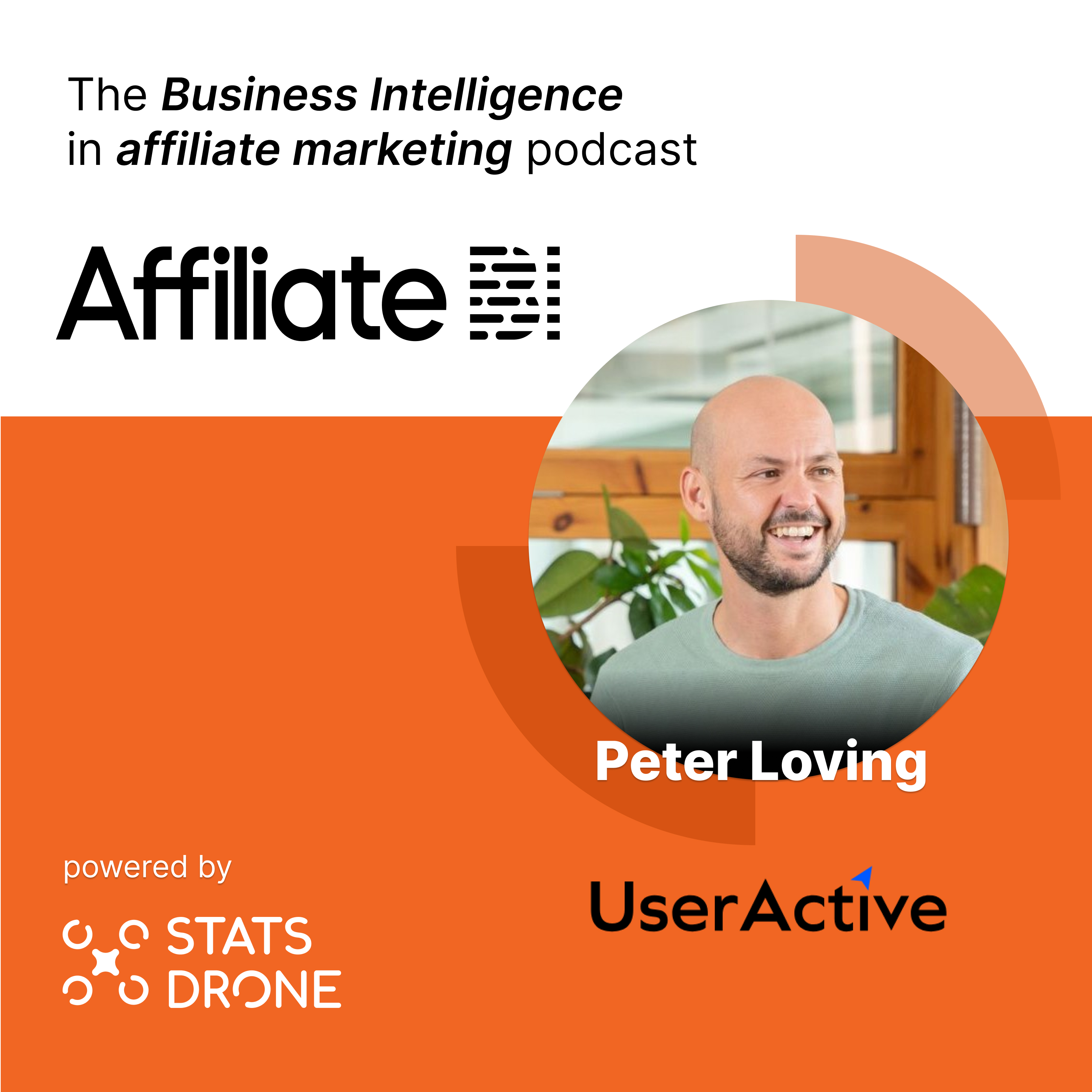
Product Design & UX/UI in Affiliate Sites with Peter Loving
Guest: Peter Loving
About This Episode
Peter Loving is the CEO and founder of UserActive, a SaaS design agency focused exclusively on SaaS app redesigns. So why did we have him on the podcast?
I believe product designers are not making their way into affiliate sites and I wanted to get Peter's thoughts on this trend happening with the larger affiliate companies.
Full Transcript
Show: Revenue Optimization with StatsDrone
Episode: Product Design & UX/UI in Affiliate Sites with Peter Loving
Host: John Wright
Guest: Peter Loving
Published: Thu, 09 Nov 2023 10:59:00 +0000
Duration: 37:24
Speaker labels are a two-speaker split from pauses (host vs guest). Timestamps are `[HH:MM:SS]` from the episode audio. Light ASR; names and brands may need a pass.
---
John Wright: When a SaaS company gets to Series A and beyond, they'll usually start hiring an in-house product team and that will consist of a head of product, product managers, and product designers. You might also have UX people. If they're not a designer, they could be a UX researcher in there. That's usually the stage at which companies start to take product design quite seriously. But before that, you get a real range of different levels of investment in design.
Peter Loving: I'm John Wright, and you're listening to Affiliate BI, the business intelligence and affiliate marketing podcast brought to you by StatStro. Welcome to the affiliate BI podcast. Today, we are chatting with Peter Loving. He's the founder of useractive.io, which is a SaaS design agency. He's a speaker at many UX. He speaks a lot on UX at conferences like SaaS stock. And I happen to be one of his happy clients using useractive to redesign our SaaS app. Peter, I want to welcome you to the show. Thanks for having me, John. I'm excited to be here.
John Wright: I want to get things started off by asking, what is your story of how you got into product design?
Peter Loving: That's a good question. I was always interested in creative pursuits generally. From a pretty young age, I remember being into art and music. And I remember actually designing things as a kid with sketching and drawing. So when it came to choosing career paths, design was an obvious choice for me. I just had a natural affinity towards design. So I studied product design in university, and that was actually designing consumer products. So 3D gadgets, the kind of
Peter Loving: things that John and I have for Apple designs, iPods, MP3 players, and phones. But after finishing that, at that time, tech was really interesting on the web. So I pivoted. And all of the core skill sets from product design that's in 3D tangible products really apply. It really translates to digital. So a lot of the thinking concepts and theory is all the same. So the transition was really just relearning the technical aspects of web development and design
Peter Loving: tools. And then I basically, in London, designed as a freelancer for maybe 10 years in agencies around London. And then it started my own agency. Useractive is actually the second agency I've started. And I basically decided to make it hyper focused, do one service for one audience of the thing that I really am passionate about. So that's product design for SaaS companies. So I get to think about products and solving problems with products and making them look great as well. And I get to think about that all day now. I think just from having the
Peter Loving: opportunity to work with you, it's you take a creative process and you streamline it as if you're an engineer or architect. So I just find it interesting that very challenging to combine creative and structure and engineering all into one. Yeah, it is actually. It's taken us maybe three years to get our process because it's been an it's a bit like working on a product, John, because you know, you're always finessing things, you're iterating over it and improving and improving it. So we've done that with our process, just working with many customers over the last three years, always refining that process to get it to be as smooth as possible.
Peter Loving: And I think that really translates to design when you're working on a product to similar kind of process. And I wanted to bring you on for a different kind of angle. I mean, we're obviously doing a SaaS for affiliate marketers. So the topic today is always affiliate marketing. But after working with you, I strongly believe that if I had to start a website and affiliate website all over again, I'd actually want to use your agency. So the irony is that you're going to focus on SaaS companies, not affiliate sites. So I just wanted to pass it back to you of what do you think about that? Maybe as a compliment, but maybe you have a look
Peter Loving: at affiliate sites and see people just not really thinking user first all the way. Yeah. Yeah. So we've designed a bunch of affiliate products. So it's familiar to us. And when you said website, John, were you referring to the affiliate marketing website
Peter Loving: or the platform? More the actual websites, like people just doing like blog posts where they've got different links and banners and comparison sites, review sites. I think we're seeing a big evolution of these sites where they're becoming a bit more professional, more organized. But they're, I think the ones that do it well and the ones that are ranking stronger, they seem to have the user experience kind of down. And if you look at the companies behind them, there's a lot of head of products or CPOs behind these as jobs behind these big affiliate companies.
Peter Loving: Yeah. Yeah. Well, first of all, I appreciate the compliment. And I understand that the,
John Wright: why you might be thinking that way. And it's because fundamentally when we're designing, we're always thinking about the end user. So we do our best job to really understand them and their needs and their goals. So the more intimately we understand them,
Peter Loving: the better we are to then think from their perspective of giving them the things that they need. So at the beginning of any product or website, that's the process that we go through. It's really getting to understand those people. What are they looking to achieve and what result do they want? And then when we understand how they usually get that result, we can create something that replicates that process and delivers that result for them online.
Peter Loving: So whether it's a website or a product, and it takes time getting to know them while spending time with them. We usually do user interviews and research, or we might ask them questions or ask them, find out a bunch of information about how they currently achieve the results that
Peter Loving: we're looking to help them with. And essentially we create an automated way of doing that or an alternative way of doing that, whether it be a website or a platform. And that's really the fundamental part of getting good design is understanding the user, knowing the problem, we really define the problem. I mean, that's really key because then we want to solve that problem for it. So like if these are affiliate marketers, we want to know their big problems and we'll solve those in design. And that's kind of going to be part of helping them achieve their goals.
John Wright: I think what I've noticed is I think a lot of people, they always want to take shortcuts, like they take shortcuts and content, like they want to do 500 words instead of 2500 words. When it comes to design, I mean, they'll spend minimal effort. And I think what you said is very true that you have a process, but I believe most people, they either don't do this process at all. And if they're going to do it, they actually spend the least amount of time. And I think you're basically advocating people slow it down and do the opposite. Yeah, I guess it's a thing that what we've seen happen a lot is if you skip that step, sometimes it gives you more work
John Wright: because you make assumptions. And when you make assumptions, you do a bunch of work based on those assumptions. And you later on, you might find out that some of the assumptions you made were not correct. And it means you have to go back and rework them. And then when you get deeper into understanding it, and you're reworking them, you might find you need a little bit more insight or information. So then you kind of go back and learn and understand what you needed to know. So in the beginning, it seems like a little bit more work. But actually in the long term, following that process saves time down the road and helps you get to the solution faster.
John Wright: That's what we found over and over again. And what I'm seeing for a pattern here is I had the opportunity to ask one of the largest affiliates that have ever come across. And I said, What was the key to your success? Or why were you able to grow when everyone's kind of like chasing in their tails going, you know, I want to be like the 20th best affiliate. And this person's like in the top three. And he said, most people don't have a long term approach. And I think with what you're saying is kind of the same thing. When you have a long term approach, you basically say, let's lay that foundation or the process to build what we're doing and say,
John Wright: well, when you have a long term strategy, you think about everything in detail, especially I think the design part. I think so too. I think so too. Also, what I found is that things usually require more patience than we expect. They usually take longer. So working on a new affiliate website, most people will experience that it takes longer than they estimated.
Peter Loving: And so having a longer term view just enables you to avoid that little desire to cut corners
Peter Loving: and invest in processes to try and get things done properly. And yeah, we try to factor in sometimes, you know, the fact that sometimes things take longer than you think. And also you don't get
John Wright: as disappointed quickly. I can imagine an affiliate marketer who's aiming for quick results.
Peter Loving: And when they find out that things take longer than they anticipated, you have that sense of disappointment, which could give you the feeling of, oh, should we give up? Should we change course? Whereas if you have that long term view, you're going to be a bit more resilient for those kind of occurrences and those types of feelings. When things take a bit longer,
John Wright: you can have the attitude of, okay, well, that's unfortunate, but we're in this for long term. So we're just going to learn from this and keep going. And we're going to get to our goal eventually. So I think that mindset helps quite a bit. And it's a pretty rare mindset. Thinking about the process you have for taking a client like us or anyone else that wants to redesign their SaaS, tell us the process of what those users go through and how you kind of build out a workflow for Redesign. Because I believe your answer to that is literally going to be a perfect
Peter Loving: workbook or playbook for affiliates that they could use. Oh, cool. So yeah, we approach things. We have two different types of engagements. One, it's where we're designing something new. And the other is where we are redesigning a platform that already exists. Did you want me to focus on the redesigning of a platform that already exists?
Peter Loving: I want both. Let's start with one, though.
John Wright: With a new one.
John Wright: Yeah, let's start with new, brand new.
Peter Loving: So when we start with a brand new platform, that is where we go on. We have to do some discovery. And that is where we're really understanding the users. So who are these affiliates? How do they work? What are their motivations? What are they trying to achieve? What did they consider like a success for outcome? What their desired outcomes look like? So we get to really understand that. But we also do understand the landscape around them. So the business model of
Peter Loving: the SaaS company, what they provide to affiliates, how they monetize that, how the affiliate perceive the value in their product or their business. So we understand the whole business case. And we really need to because otherwise we're not going to be able to design effectively for it. So that usually takes workshops and UX research in the beginning. So that's the first kind of phase. When we have all enough information to be able to design something effective, we go into wireframing. So for people who are not familiar with what wireframing is,
Peter Loving: it's where it's like mocking up a blueprint. It almost looks like an architectural drawing. There's no color. There's not a lot of detail. There's no actual content. But we're just using
John Wright: black and white layouts and using blocks to indicate areas of content. And we form the structure of screens that would make up this software. That enables us to resolve things like functionality, navigation, what are the key screens, how do users move through the app. And then we add more detail in. So that wireframing process can get to the point where we have something that's quite detailed and quite resolved. When we feel like the user experience is very
John Wright: resolved, then we move into UI, where we're adding color and treatments, graphics, icons, typography,
John Wright: illustrations, different messages that might occur along a user journey, like confirmations or progress indicators, taking users through steps of a journey. But a key thing that we'd like to do during that process, from wireframing right through to UI, is that we go back and we check in with users. It could be the client that we're working with, but it also could be their users. We put the designs in front of them and we say something like, hey, you told us that you work in this way, you're looking for this result. How does this design look to you?
John Wright: Do you think this resolves your problem? And we'll take them step by step through how something works and get their feedback. So our process is, we find it really engaging, really interesting, because we're really solving problems all the way through. Until we get a finished design, and that's where our job usually ends, because we pass that over to developers who then build the SaaS. We might be involved with them for QA, supporting them as they implement it. And then sometimes it's just a general ongoing case of
John Wright: designing, adding new features, improving the platform, iterating as things change. And as the company learns more about their users and their SaaS. And now for a redesign,
Peter Loving: they can have different requirements. So if a client comes to us and asks us to redesign their platform, we will start off with the discovery process of understanding what are the problems, what's happening in the business, and what's the motivation for the redesign.
John Wright: We find a bunch of things. It could be that the product looks dated, and it's not really standing out against competitors. So less people are signing up to use the platform because of the lack of perceived quality. It could also be that there could be some legacy technical debt in the product. So things are very hard to change. It's very slow every time they want to update something or release a new feature. It takes a dev team a lot of time and effort. So clients have asked us before to help them redesign the platform so they can build it again from scratch.
Peter Loving: Once they do that, they realize, okay, now we have systems that can help us develop twice as fast as we used to. And then we can release and ship much, much faster with the platform. So it does depend on what's happening with the business at that time and what they need to do. And we'll take that on board, and then we'll go through the process of redesigning. So we take what they've already got, reassess it, and we look at how we can improve things. If there are confusing areas, say the navigation might be confusing to their users, we'll go through and
Peter Loving: redesign, restructure the navigation, make it logical, group things in the logical fashion, and make sure that there's contextual navigation. So wherever the user is in the platform, there's always something that helps them navigate to whichever journey, whatever task they want to achieve, and that it's really clear and intuitive.
John Wright: And then we'll work through other areas. Is the product difficult to use because there's not enough guidance? Then we'd design the user flows to make them easy, but also include some steps to explain how to do things, just make it much clearer. But generally, a lot of time what we're doing in a redesign is improving the user experience and modernizing the UI, bringing it up to a very modern, clean aesthetic that enables the perception of that platform to
Peter Loving: dramatically be improved. And usually we find that that is quite a big boost to a SaaS company, because they find it a lot easier to get users on board and for those users to upgrade and want to give the product a try. As an affiliate marketer, you'll want to celebrate your first sale, learn about a drop in clicks and revenue, discover new brands, be notified when programs close, see an increase in earnings per click, identify underperforming campaigns. Your affiliate
Peter Loving: programs won't tell you when these things happen, but we will. Whether good things are happening to your business or bad, we are here for you and we've got your back. Staff Throne is the number one affiliate CRM tool that helps you get your data, manage your biz with CRM tools, and analyze data with business intelligence. Visit staffthrone.com or find the link in the show notes.
John Wright: Halfway through the redesign as we're building things, I think some of these ideas become clear. For us, we almost feel like we had an aha moment where we were building tools that are more data focused for affiliates and we're thinking maybe our angle or our core messaging has more to do with CRM. The more we build those CRM tools, the more people are saying that's my biggest pain point actually. I'm wondering if you've had with other clients any of these unique transformations or unique discoveries that have happened. Yeah, one really springs to mind actually.
Peter Loving: We worked on an events platform called Virtual Summit Software and this software would enable people to create and set up their own virtual summits and host it. It would give them a web page, you know, that it would also enable them to have a mailing list and mail out. So it was a CRM and a hosting for the virtual summit and provided a website all in one. So it did everything you need. There were three types of users. There were agencies who would be running
Peter Loving: virtual summits for their clients. There were consultants who either worked for an agency or worked for a client and they were just an independent one-person business and they were setting up or supporting companies with their virtual summits. Or we found business owners who would be using their own business. They're setting up their own virtual summits. And we did a series of interviews with all of these different profiles and we found that one stood out as a real champion
Peter Loving: for the product. Who gets the most value, who's the most committed, who will put the work in to get the results the platform can give them. They got the most value and that was the business owner who's running a virtual summit for themselves because they were very invested because it was kind of marketing their own business and they also knew everything that they wanted to put into their summit. The agencies had a lot of restrictions because they were doing things on behalf of other people. They'd run into a lot of blocks. They wouldn't be able to have access to things or they wouldn't know the answers to all of the content and they just generally struggle.
John Wright: So a lot of them eventually would churn or they wouldn't finish and actually get to launching the summit. So basically we redesigned the product to really focus on the business owner profile and that really helped engagement with that software. So once we focused on that user and that use case, then they realized that the product fitted them even better and it gave them the tools that
John Wright: made it easier for them to run virtual summits and all the support. So yeah, it had a really good impact and it definitely helped them get more users. They started to get more free trials when they promoted through marketing and they also increased their free trial to paid upgrade conversion rate. So yeah, that kind of thing can happen quite often when you go through that process. You just learn more insights and it helps you to focus on the most impactful area.
Peter Loving: Now some of these things for customer interviews, I mean we kind of associate them with SaaS
John Wright: but I don't really see them in affiliate marketing and I'm wondering if this topic of customer interviews, things like CSAT and NPS like Net Promote of Score, there's all these metrics that SaaS companies are starting to use to really get more data driven about what's working, what's not working and I'm wondering if you think maybe affiliate sites should be considering this of going, how do we do? What can we improve and just kind of understanding metrics beyond the standard.
Peter Loving: Yeah, I think those are always helpful if you're delivering a service to somebody
John Wright: or a product, you always want to get that feedback. Is this really serving you, are you getting the results that you need from this? Is it helping? I like NPS because it just gives you an overall satisfaction score. So you know in general, but we look at two types of data, we look at qualitative and quantitative data. So some of that is quantitative is say, we've released this feature, how would you rate it out of five and then we'll be able to get a
John Wright: score. So NPS is a bit like this and qualitative data gives us more explanation or context. So the user might say to you, oh this affiliate website is great but it's missing this information and there's such and such a thing that I've been trying to do and I can't do it. Can you either build it or do you know another platform I can use? It's that data that's really, it's harder to sort because you'll have lots of different comments but that data can be really insightful because
John Wright: that gives you the answers of what to do. So they say, quantitative data tells you what the problem is and qualitative data tells you how to solve it. So we kind of look at it that way.
Peter Loving: I've interviewed a lot of different people like Oliver Kenyon from ConversionWise talking about CRO, quite a few people in SEO and a few people in content and starting to notice a pattern that most of them say it's either 1% or less than 1% of people do these best practices. And I'm just kind of wondering for all the SaaS apps that you see, what percent would you say actually do design really well? Definitely the larger funded SaaS companies. So when a SaaS company gets to Series A and beyond,
John Wright: they'll usually start hiring an in-house product team and that will consist of a head of product, product managers, and product designers. You might also have UX people. If they're not a designer, they could be a UX researcher in there. That's usually the stage at which companies start to take product design quite seriously. But before that, you get a real range of different levels of investment in design. We see that if there is a co-founder with a
Peter Loving: design background, then it's valued more from the beginning. But that's actually quite rare in SaaS.
John Wright: What happens typically is that products get built with engineers. Usually the engineers will be the people designing the product. They'll build something that technically is very good and it could be feature rich. But what happens is that they'll get to a certain stage where they have traction and customers and they'll either get feedback or realize through their own observation that product needs to have a better experience and needs to be designed better.
Peter Loving: Usually around that seed stage or if they're bootstrapped, it could be five to ten years into the product journey. They really look to invest in design or they start to appreciate the value of it and the impact that it can have on their business. It varies, but I look at it more as a stage thing for SaaS companies. Part of that comes down to just the access to the resource that they need because building a SaaS is expensive and it takes a lot of effort, skill,
Peter Loving: and resource. Many early stage companies just don't have the resource to invest in design.
Peter Loving: They'll prioritize development and then maybe product marketing. It's all a case of when they get to the point where they feel they're able to do it. Yeah, it makes sense. I think that's maybe why we were drawn to your company in the first place where I've got a design background. I've had an appreciation for the work, but I was very tempted to do it myself, but I'm very grateful I didn't. I'm definitely not going to compete with you ever again. Yeah, well, we always say that
John Wright: the founders and C-level people in the business should really be working on the business and they'll make the most impact there. Design, if you think of it in terms of founder level, role design is really taking them away from the areas where they'll have the most impact. So we would consider that to be something that should be delegated,
Peter Loving: and either in-house or to a team like us. The benefit of us is that we just have so much insight into SaaS and we're very specialized. We see hundreds of SaaS products and we design a lot of SaaS. So we can bring the equivalent of a product team insight to a business.
John Wright: But yeah, it's better. I think your impact, John, is definitely more that there's a lot more impact that you can make with finding your next funding round or speaking with customers or making sales.
John Wright: So for me, it's quite great that we can actually liberate that from you so that you can focus on those impactful areas. And let's assume that in building an affiliate site, you only had one person to hire on the design team. My thesis or theory in doing this interview with you was that I believe maybe more product focus or product design is more important than a regular designer. So if you want to build a website or design it, usually you find a design agency and you go with them. How would you look at this process a little differently? What's the person you would
John Wright: personally hire if you had to build your affiliate review site or comparison site?
Peter Loving: If I had to hire one person, yeah, because there's quite a lot that goes into it. Usually, in an agency, you'd have a project manager, someone dealing with content. That could be a team copywriter and then somebody else with a content strategy. And then you'll have a designer and you might have somebody managing the process to the client.
John Wright: But from our side, a good designer has a broad skill set, especially in product design, because product designers need to have a technical... And you could say this for general website designers too. But they need to have a technical understanding of development, how things are built on the web in order to design for the web. It's really important to have that skill set.
John Wright: And then the design skills and design theory of what is best practice, what makes user experience really effective. And then an experienced designer has been exposed to project management and is able to plan and project manage each of their website design projects too. So I think I'd hire
Peter Loving: like quite a skilled web designer for that task, quite a skilled web designer, because
John Wright: what we see a lot of is people hiring junior designers, especially in early stage SaaS. We see that quite a bit. And what happens is that designer becomes somebody who you have to tell them what to do and then review their work. But a really great designer will be coming and proposing to you the best way to do something. Hey, this is the most effective way to create your website. They'll challenge your thinking and they'll have the domain expertise to be able to do that. And then if they're experienced and talented and skilled, then you benefit from
John Wright: the insight and the feedback that they provide into that process. So we tend to hire
Peter Loving: mid to senior level designers because they lead the projects and they're able to consult.
Peter Loving: But with juniors, it takes up a lot of time to manage them. So I think of it in terms of the level of the designers experience is really important. That's really important. So yeah,
John Wright: an amid to senior level web designer, I think I'd go with.
Peter Loving: And although this was a curve ball, like bringing you on to our affiliate marketing podcast, I still want to finish off by saying, what do you see the future of affiliate marketing as it intersects with business intelligence? Oh, that's a tough one. Well, the trend of AI is huge, isn't it right now? So what we've been seeing is the software that's making quite a bit of impact in the marketplace because of the trend and the bonds around AI means that
John Wright: those products have been getting the most attention and people are trying them out more and people are very interested in how that's going to shape their work and their industries.
Peter Loving: So I am convinced that there'll be more and more AI automating the work of affiliates.
John Wright: And the business analytics and reporting around that is going to be able to
Peter Loving: mean, I think it will mean that you can probably make faster changes to your campaigns.
John Wright: Of course, correct or try new things. And what we're seeing in products on our side is
Peter Loving: AI being done on scale, but then also personalization being introduced to the AI so that it doesn't look like it's actual AI work. So that a good example of this, we worked on a product that
John Wright: produces content. So you can automate your content production and it will use things like chat GPT and mind journey to create images and create blogs. But then there are other tools that you will then put those blogs through to make that content look like it's been written by a person rather than AI. So then Google or readers of the content wouldn't really be able to detect that it was AI. So I think this kind of thing will be brought into affiliate marketing
John Wright: more and more just to deal with the heavy lifting and then analytics will be used to course correct. What do you think? Does that sound like something that you think is either happening or can happen? I think so. I mean, I can look at it for multiple different angles. I mean, from my side, just being a company that's not even profitable yet, we're seeing a lot of interest in customers, the discussion, companies literally want to acquire. So we're seeing an interesting thing on just the data side. And we don't even have to touch AI for it to be interesting.
John Wright: But I think from your point of view, this is where I think you have a really unique advantage is you get to see the growing up and coming SaaS companies of either the future or that are happening right now. So I think your perspective is a unique window. And it's funny that you brought AI into this topic where I didn't even have an AI question, but quite frequently, AI comes up over and over again. And I think there's a weird intersection of AI, but also understanding that not everyone wants to interact completely with AI. And it's like, where do users fit into this context? And where's the human element in touch? And I think we're going
John Wright: to see a weird world where AI and business intelligence and analytics are, they're going to be driving a lot of data driven decisions to make things happen, whether it's affiliate sites, SaaS companies, content, it's all going to change. Yeah, I think that's the really interesting thing that's kind of being developed right now. It's how we interact with AI and the human element, exactly as you mentioned, because there are some tasks that can be automated completely without
John Wright: necessarily having human input or interaction. But there are areas where AI is being used that has a lot of human interaction. So it's like, how do we keep that involvement so that people interacting with AI have a good experience and it's not just alienating. So I think that's going to be something that we see over the next couple of years, unfold a little bit more. Peter, this was very insightful. I love chatting about design, product design, UX with you. Obviously, we're a customer, so I'm a big fan of the work you do. How can people get a hold of you?
Peter Loving: Yeah, so you can check me out on LinkedIn. It's Peter Loving, Peter Loving on LinkedIn.
John Wright: We also have a YouTube channel, so we're user active on YouTube. That's our channel. We talk about design topics on there. Yeah, and you can visit our website, useractive.io.
Peter Loving: And you can find all of that information in the show notes. Peter, thanks so much for joining us. Thank you, Jon. It's been great to be here.
John Wright: And there you have it. That was Peter Loving from useractive.io. And I just want to add one more insight to everything that he shared with us today, which is a lot of really large affiliate companies are now starting to hire people in the product department. So it's not just a trend that we're talking about it with Peter, with his company, but affiliate marketers on the larger end are starting to incorporate this. And now it's at that time where I asked you for a little bit of help, which is, as of today, we only have two ratings on Apple podcasts. You can do me a favor if you are a listener on Apple to give us a rating and review,
John Wright: or do that wherever you listen to your podcast.