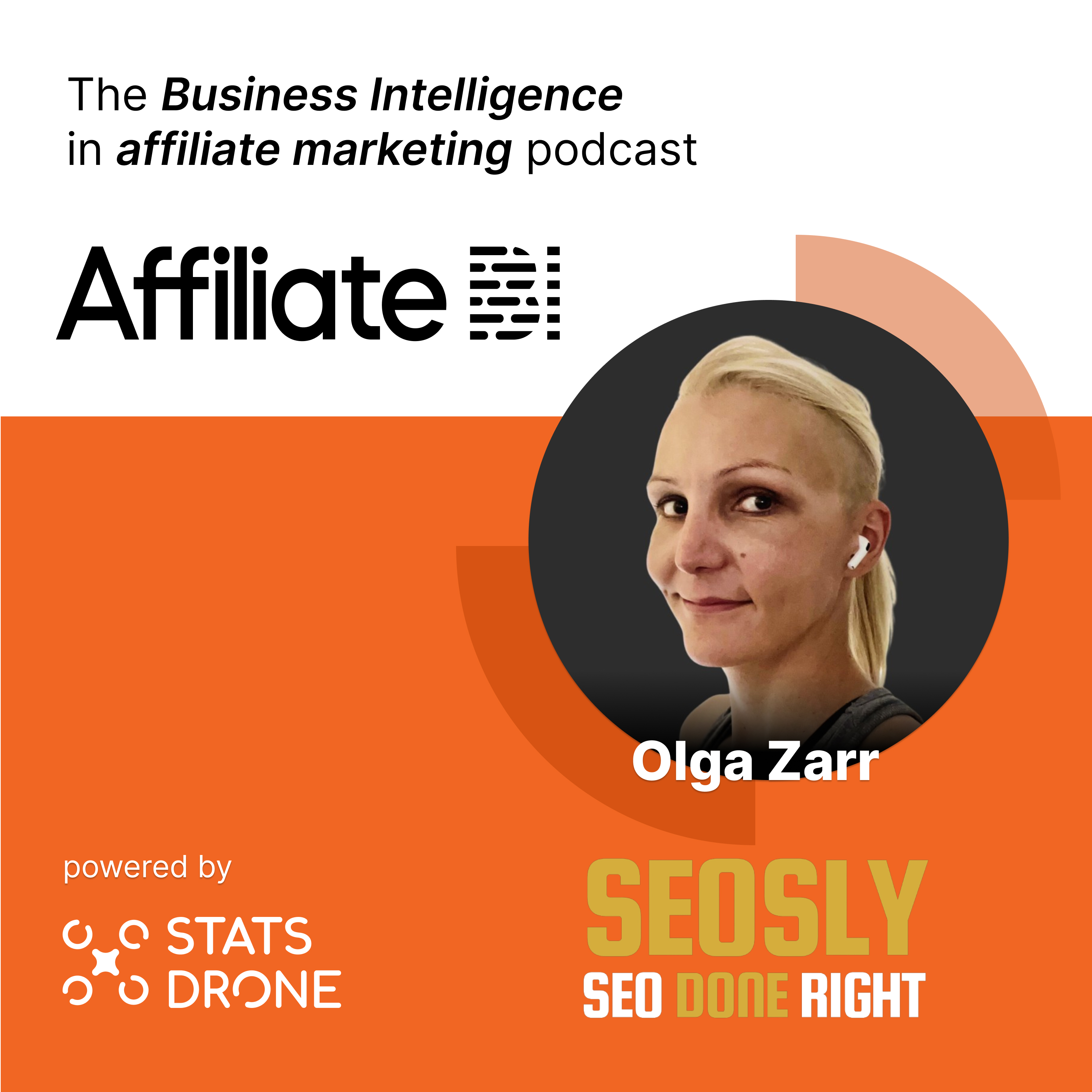
About This Episode
Meet Olga Zarr who's an SEO consultant who is super into using AI for anything SEO related. Despite that, she does believe that you'll always want and need a human element in your content, in your affiliate sites.
Plus see what she had to say about Craig Campbell to start things off.
Full Transcript
Show: Revenue Optimization with StatsDrone
Episode: The Affiliate’s Guide to AI-SEO Synergy with Olga Zarr
Host: John Wright
Guest: Olga Zarr
Published: Fri, 22 Mar 2024 06:43:00 +0000
Duration: 38:12
Speaker labels are a two-speaker split from pauses (host vs guest). Timestamps are `[HH:MM:SS]` from the episode audio. Light ASR; names and brands may need a pass.
---
John Wright: But initially, when it all started, I was like, wow, now I can be creating articles for my blog, like, every day, 5,000 words, and it will be cool, like, everyone had this wow effect. But when I started playing with that a little bit more, then I quickly realized, and I am almost certain about it now, that at least now, those AI tools won't replace that human element, that human brain.
John Wright: Especially when we are talking about the business that has a brand, has a name to it, like in the case of me, when I have my blog, and I am the author of all the articles, all the videos. I don't think I could massively use chat GPT or any other AI tool to grow that.
Olga Zarr: I'm John Wright, and you're listening to Affiliate BI, the Business Intelligence and Affiliate Marketing podcast, brought to you by Stadstrom. Welcome to the Affiliate BI podcast. Today, we are chatting with Olga Tsar. She's an SEO consultant for herself, and she's also the host of the SEO Sly podcast, which I'm a fan and listener of. Olga, welcome to the show. Hi, John, I'm very happy to be here, and I'm very happy that you also were a guest to my podcast in the past.
Olga Zarr: This was a very popular episode, but I'm pretty sure we'll get into that. So happy to be here. Yeah, and once again, thanks for having me on your show. And I can literally tell you I've had affiliates sign up to our app because they heard of that episode. Out of all the different shows I've been a guest on, yours is actually driving the most leads. So it's amazing. That's cool. That's cool. Yeah, yeah. Very happy that it went this way. Yeah. So one of the questions I usually ask people is like how they got started into SEO or whatever they do.
Olga Zarr: Of course, with a guy like Craig Campley, he's like when I interviewed him, he's like, I don't want these BS questions like how you got started in that. He's like, I want something different. So I want to start this off of what do you think about Craig Campbell? So I love him. I love him very much. I am a huge fan of him. So I think he's a perfect person who is in between the two worlds, the black hat and the white hat. And he's kind of the in between blending the two together perfectly. So huge fan of him.
Olga Zarr: Yeah. And for me personally, I look up to Craig because he's been doing video for a long time. And I think he just kind of knew like, hey, I can write a blog post, but I can do a video, get 10 times more traffic, have no one competing against me. And I think for both of us running our own podcast, I think we know the power of video where not everyone wants wants to do it. And it's an extra channel to rank for it and also get more conversions. Yes, yes, totally. And I think Craig is one of those SEOs who have the biggest number of, I think, views and subscribers in the SEO industry if I'm not mistaken.
Olga Zarr: So he definitely knows what he is doing. And regarding YouTube, I was also very hesitant. I didn't want to do it for a very, very long time. But I finally kind of understood that this is the way to go. This is a very important channel we cannot neglect if we want to get more clients, more business and grow as SEOs. Well, thankfully, you've done that because again, I'm a fan. So let's go to the very beginning of how you got started into SEO.
Olga Zarr: Yeah, so I think as everyone, it wasn't like a plan or anything like that. So I basically graduated from university. I started my own translation company. And when I got to the place where I had to build my own website, I learned about SEO. Then I learned about this program called Site Build It. It was like 2009 or something like that. And then I heard about that you can build a website, you can earn so much money from AdSense, from Affiliate, from Amazon at the time.
Olga Zarr: So I became like crazy about that idea. And I started building sites like crazy. Mostly they were reliant on Amazon and AdSense back then. So I was able to earn some money back then. But those sites were wiped out by Penguin Panda, most of them. But I knew that this is what I want to be doing. And here we are more than 10 years later, and I'm still doing SEO. And who are some of the most underrated SEO people that you know that you think we should follow?
Olga Zarr: So definitely I think this is Miriam Jassier. I think she already has a huge following. But in case someone doesn't know her, I think she should be the person to follow. We also, together with Miriam, we do SEO cash flow episodes where we talk about the money aspect of being an SEO. And we are very, I would say, courageous with topics. We are very open about what we think about, for example, pricing our services.
Olga Zarr: So some of those topics are episodes quite controversial, but I think definitely Miriam, an SEO trainer, a great person to follow. And another one is Adriana Vujadin. She is an SEO mindset coach. She teaches people about the aspect that no one really talks about, the mind aspect of being an SEO. And I even recently had a coaching session with her, and it really helped me at home because I am now at this stage where I'm not really sure where I want to go next in my SEO career.
Olga Zarr: And the coaching session with her really cleared a lot to me. So these two for sure. But of course, I can name like 50 more people, but let's stick with them for now. We'll start with these two, and then maybe later off the show, I'll get like a top 10 or top 20 list. We'll do that as a separate post because I'm actually discovering some interesting episodes of seeing these people that for me are under the radar. But when I look them up, it's like, yeah, some of them have followings greater than I do. Yeah, perfect.
Olga Zarr: And so now the opposite is give me your top three episodes and like from your own show and like ones that have like, you know, the most profound insights and learnings. So it's been almost, I think, almost close to 100 episodes. So it's going to be a tough choice. But I think definitely the episode with you, which which was about SEO for gambling and casino websites. I got a ton of feedback from this episode that no one is talking about this, about this. This is a very, very interesting topic and the way you talked about it. So definitely this one.
Olga Zarr: This is this is a territory that people are really interesting in learning about. And I would love to learn about it as well as well, because I haven't been doing this type of SEO in my in my career. So this one and then I would say episodes with the episode with Ted Kobaidis from Cora, when he talks about Cora and like doing SEO in a more critical way.
Olga Zarr: And the other one with Lee Witcher, who is also from SEO Fight Club and where he talks about doing SEO testing and again, being a more having a more critical approach to SEO. So I would say these three. OK, that's interesting. Ted, I'm definitely going to have to tune in to now going a little deeper, because you said like, you know, the casino was interesting and I come from the gaming space. So I've been in the space for over 20 years. And what I find interesting is that there doesn't seem to be a lot of active SEO people that they put their name and say I am casino or I gaming SEO.
Olga Zarr: And the ones that I find who are some of the best SEOs in that space are obviously the affiliates that are actually dominating. And it's kind of like a weird mix. It's almost like it's, you know, the SEO consulting business is just massive globally. But why do you think maybe there's not a lot of people just kind of doubling down and saying, you know, I'm exclusively just going to focus on this niche. And it's kind of weird that I just think a lot of people aren't sharing a lot of info in this in this niche.
Olga Zarr: Yeah, yeah, yeah, I think I think this may be to do because with affiliate, as we can see, when Google changes something, when Google introduces helpful content updates from what I heard, from what I see. In many cases, affiliate sites, which in many cases are the sites that earn a
John Wright: a ton of money, are the ones that suffer the most. Maybe not the most, maybe this is an exaggeration, but I would say a really serious affiliate sites bring a ton of money, earn a ton of money. And this is a serious business. And I think this is why a lot of people who are doing those things, they do not want to talk about that publicly. They do not even want to put their names on their site because they don't want competitors to report them or to copy them or to do whatever. So I would say this is probably why. What do you think?
John Wright: I think there is a lot of truth in that. I mean, Better Collective is a publicly traded gambling affiliate company. And I think last year they posted revenues of 373 million euros. So it's up there. And I've heard there's a couple other companies that are doing similar numbers. And these numbers, they're just growing. You can basically check out like gambling.com, RakeTech, just to look at like, you know, what are some of the public companies are doing. And when you talk to affiliate managers and ask like what's happening in the background, it's weird because the space is it's growing, but it's getting a bit smaller.
John Wright: Like bigger affiliates are buying more affiliates and Better Collective, I think they just said they raised like a billion Danish kroners for for more M&A action. So it's it's a weird space. And those big companies like I don't know, I'm not sure if New York Times does that, but all those big companies also started to started to enter this market because they have big domains, a lot of authority. And they also started creating affiliate reviews like crazy and competing with those smaller ones. Right.
John Wright: And now we're going off on a really good tangent because a lot of those companies, they're setting up partnership deals with like USA Today, Washington Post. So they're basically saying, we'll do your affiliate marketing for you and we'll give you a cut. And I'm not sure what the cut is, but it could be like they keep like 50 or 70 percent of the business. And on the opposite end, I know some big affiliates that they're actively buying these media companies going, can I buy a newspaper for the explicit use of turning it into an affiliate site? And it's funny that this has grown really popular. And then now we know what's happening today, like Reddit and Quora is going through the roof.
John Wright: And I'm taking advantage of that right now. I just started like an affiliate software subreddit and it's like, yeah, it's kind of like Parasite SEO. Yeah, yeah, totally, totally. Parasite, I think 2024 is is the year of Parasite SEO, definitely. I love it. So when I joined your podcast, this was like a year and a bit ago and AI was just getting off the ground. And I know you were getting deep into AI when I started watching your shows. I'm like, wow, the conversation we had for our episode and like one or two months after I'm like, OK, I know you're spending a lot of time on on AI.
John Wright: So I wanted to ask, like, what have you been learning about it? And, you know, how does AI look in your workflow today as well? Uh-huh. To be honest, I wish I could have way more time to be playing with all those tools. Of course, of course, I did what I could. But initially, when it all started, I was like, wow, now I can be creating articles for my blog, like every day, five thousand words. And it will be cool, like everyone had this wow effect. But when I when I started playing with with with that a little bit more than I quickly realized, and I am almost certain about it now,
John Wright: that at least now those tools won't replace that that human element, that human brain, especially when we are talking about the business that has a brand, has a name to it. Like in the case of me, when I have my blog and I am the author of all the all the articles, all the videos, I don't think I could like massively use as massively use chat GPT or any other tool to grow that.
Olga Zarr: But I see a space where I can test and I've been doing that weather, AI content and how well proofread AI content can rank. And I created a batch of websites purely with chat GPT content. And so far, they have been doing really, really well. But I am but I I expect that at some point, maybe they will tank. Who knows? So this is this is an interesting exploration path, but but I'm still kind of holding on to this human element.
Olga Zarr: And in my day to day workflow, of course, I use chat GPT, Bards and those other tools. I also like Claude very much. I think I like it even more than than chat GPT at this point. So I use them in those daily SEO tasks like helping me craft newsletter or make it shorter, shorter, make it better or social media posts or even writing or completing or making the recommendations I put in in the audit better. So this is basically my my SEO assistant that can help me on a daily basis.
Olga Zarr: But I don't trust it with very, very complex, complex tasks yet. I also played with with a tool. This was a very complex thing to set up where I would basically type a prompt. And based on that prompt, a very, very long blog post would be created, published on WordPress automatically. I created a bunch of sites this way, including videos.
Olga Zarr: But the quality of that wasn't really there. So the sites that rank, which have a content, they were created in a half manual way, I would say. I asked GPT to create a good outline. Then I reviewed it. Then I was doing I was going back and forth at least five, ten times before I put an article. So so this was written, but not automated, like within just one click of a button. Maybe I'm not there yet when it comes to creating very, very high quality articles.
Olga Zarr: But I think it's still not there. What do you think? I agree. And I actually wanted to bring up a point where I was I've interviewed a bunch of content people and one of them that comes to mind is a girl named Lachey Lewis. And she does B2B content and she likes focusing on bottom of funnel content. And she was on a podcast that I listened to recently and she said, what's you're going to use chat to ask questions like what is SEO? Where can I learn SEO? But when you get like super niche of like asking specific questions, that becomes bottom of funnel content.
Olga Zarr: And that those are things that she said that you're not going to you're not going to ask chat to be T for answers to those bottom of funnel questions and bottom of funnels where you see a lot of conversions in everything. You see conversions and sales for what you have to do. We see it in our side for as a company. And I actually think a lot of the conversions that affiliates make are bottom of fun. So I actually think it's like the top of funnel might actually start becoming watered down where who's going to really care about rankings of top of funnel content.
Olga Zarr: If if bottom of funnels going to be maybe the future, it's like I think we're going to become accidentally educated that, wait a minute, I don't want top of funnel content anymore. It's boring. I know it's probably written by chat. GPT. I think we all know we want the human element. And I can't imagine like some of the bottom of funnel content that we want to create. I'm like, there's no way I would ever publish with chat. GPT. It's it's to me, it's impossible and off limits. Yeah, yeah, totally, totally. And I think like assuming that SGE will start growing, will be like present with every query.
Olga Zarr: It is quite possible that, for example, the SGE will be will be answering those types of questions like what is SEO right? And those types of questions, even if we have content for that, it won't probably be displayed very highly. So so this is this is this is I totally agree with that as well. So I want to shift to Looker Studio because I know you've you've done a bunch of Looker Studio templates. And I just want to ask how you build dashboards for clients. And do you find you can sometimes do a one size fits all or are you finding with your clients that you tend to build more bespoke because their needs are always just different?
Olga Zarr: Yeah, to be to be honest, the question the answer is the most popular answer in SEO, which is it depends. So I have this this this template I shared and it is quite comprehensive. It has data from GSC, G.A., and I think SC ranking. So all the basic SEO, SEO elements are there. In many cases, this is already a lot for the clients, a lot of data. So in most cases, it is enough enough. But but there are some clients who want more. They want to see specific things.
Olga Zarr: They want to they want me to pay attention to specific things like some clients care more about specific rankings. They don't care about traffic, but just they want to see that they are ranking number one there. And they want to see screenshots of that every day. So this is the template. But whenever there is a need, I am happy to to change that, to change that so that they actually can track what they want to track what's the most valuable for them. So that's what I would say.
Olga Zarr: And some clients, for example, want me to simply check what's going on on a different on a different month and simply put in a Google Doc. My thoughts, my observations, they can be from a screenshot from a trips, a screenshot from GSC, from Serbs, whatever. So this is also a very bespoke, I would say, model like I I look at this like from a higher level and select what what I want to share. Yeah, I'd love to be able to look at all of them. But obviously, that's client info and confidential.
Olga Zarr: Maybe I'm going to ask my own specific question. It's like when you're setting up things that are outside of, let's say, analytics and search console. So you said you use ESSI ranking and sometimes a customer will want other data sources. How much does this typically cost for like what's it cost for you to set up that Looker Studio template? Like what are these things cause if someone wanted to hypothetically do it themselves? To be honest, this is this is something I do as part of the monthly plan for for my clients. So I don't really I haven't even priced that, to be honest.
Olga Zarr: Yeah, this is like part of the plan and the plan costs this and that depending on the size, usually the size of the of the site, the complexity, how competitive it is. So but if I were to price that, I don't know, to be honest. It's tough because I know with Looker Studio, they're they're a sneaky company. I mean, it's owned by Google. And if you approach them blindly asking how much it costs, they're like, oh, it's like thousands of dollars per month. You're like, wait a minute. It's that's impossible because they have they have different plans. So if you get their sales team, they're a little super aggressive trying to put you to the max price as if you're a corporation.
Olga Zarr: You're like, look, I just want to use some search console and analytics. And like, oh, OK, that's yeah, that's free. Because because I have access to all those SU tools, this is like part of my cost. Yeah, a business cost. And and I don't like I cannot. But but this is probably the calculation I should I should also do.
John Wright: It's just curious to know what else are you also putting inside Looker Studio other than SE ranking? Like you said, you also use like, OK, you're putting in like a Google Doc because you're adding notes and that's an insight. But would you put like Ahrefs data in there as well, like separately? Or is that more in a table or is that more just in a screenshot? I would say, again, that that really depends. I am also now working on on adding data from from Jet Octopus to that. Jet Octopus also allow because some clients want to see Core Web Vitals, even though I don't think it really makes any sense. But some of them wants to see that.
John Wright: So I'm now working on connecting Jet Octopus, which also can can run Core Web Vitals reports and have them see Core Web Vitals there so so that they can see their green or orange color there. So Jet Octopus is definitely one one I would I also want to add. I add and Ahrefs as well, I would say. Yeah, but and in some cases, there is also the revenue aspect. So because it also depends what I specifically track with a given client and what's the ROI for them.
John Wright: Mostly it is traffic, organic traffic and conversions rights and and revenue. So but some clients just just want positions and they just want to see their own top. Maybe there's a chat we can have later on where we have our affiliate marketing data in our stats app and maybe it could be exported and combined. Because obviously, usually there's always a strong correlation, like if traffic goes up, your affiliate revenue goes up. But sometimes the opposite can happen. And it's really good to see your flow of traffic and revenue left to right. Yeah, yeah, yeah, totally, totally, totally.
John Wright: So if you had to give up your SEO consulting today and you had one year to become successful and making pretty good money so you know you're comfortable and growing, what would your business plan be and what would you say your goals would be to? So I would probably create a bunch of I'm I already created some affiliate websites and I'm already kind of working on that on the side. But I don't have as much time as I would like to. But I would create a bunch of sites. Each site would be devoted to an interest I have. So a site about running pigeons. I already have one about pigeons.
John Wright: So running watches, iPhones, all of those things. And definitely a bunch of sites only talking about reviewing SEO, SEO tools or having some rankings of SEO tools, because SEO tools also pay well in terms of affiliate affiliate revenue. Of course, this is not like casino and gambling. But since this is the niche, I already know a little bit this would be this. Those would be my my probably my goals. So I am working on that. But like 10, 15, 20 percent of the time.
John Wright: So probably it will take me some time. And there is this those changing happening and people I hear people from the affiliate space saying that they lost 90 percent of their traffic revenue that they are questioning whether it is really a good idea to enter into affiliate space. So we hear all those voices. And this makes me think that maybe I will stick to this SEO consultants at least part time for for a longer time. But I don't know what what do you think about what's what's what's going on right now? Yeah, well, two parts.
John Wright: The first part of like what's going on right now, I mean, yeah, I think Google is kind of they're just in an uncomfortable space. Like they want to change things, but they don't want to change it so much that they make so much money from how their business operates that they can't just like switch their Google rankings and how everything works with with SGE. So there's a lot of disruptions and, you know, it's nice to be on the side of the fence where it doesn't affect you. But we are watching our friends kind of get wiped out and just saying, hey, I have to like I have one friend, he went all in on affiliate marketing. He just got wiped out with a helpful content update and he's now back to SEO.
John Wright: And the second part is my take on this is some of the people that have interviewed on this podcast that are SEOs, many of them have their hands. They've got affiliate marketing projects and they're doing quite well. And I'm kind of noticing a pattern that some of them, they understand how much money you can make with affiliate marketing. And my belief is that when you get to work with so many different clients, whether they're in affiliate marketing or not, your skills and expertise in ranking and SEO is very strong. Like for me to be an affiliate, to compete against you, even for you to do this part time, you automatically have an advantage over me because I'm not an SEO consultant.
John Wright: And I haven't done that in a long time. I think it's a superpower. And when I watch like my SEO peers do both, I'm like, this is really interesting to watch them. They don't drop one for the sake of the other, but they enjoy doing both. And I think running your own affiliate sites also gives you the experience to become a better SEO as well. Yeah, yeah, totally, totally, totally. This is something like I created recently an affiliate site last year. It has a lot of content.
John Wright: I think I put most of my skills there, but this was a brand new domain in a very, very competitive space like gaming. And to be honest, this site is really at least still is having really problems getting out of the sandbox. So if only I had like 24 hours a day to try to figure this out, that would be awesome. But maybe one day. Yeah, you got to start somewhere and grow.
John Wright: But I have confidence that if you actually did affiliate marketing full time or even 50 percent of your time, I'm pretty confident you do pretty well. And I believe as well it's like not just being a consultant. I think you having your podcast, getting to learn what everyone else is doing in the SEO space. For me, I believe it's a superpower that you have from just basically putting yourself out there doing these podcasts and challenging yourself. Yeah, yeah, cool. Totally agree. And what would you recommend for creating a podcast as a marketing channel and a content channel as an affiliate marketer?
John Wright: Like we do this in B2B. We know it helps us in that space, but would you recommend to do this or would it be part of the strategy or what's your take on it? So to be honest, I would probably focus on YouTube. And if you do YouTube, if you do YouTube videos, then you can always convert them into a podcast unless they are like very, very visual. So I in my case, I don't think I have like the most of the business and leads purely from podcasts.
John Wright: It is mostly from YouTube and from my other where I am a guest or my articles. So this is good, but I wouldn't make it like the entire focus and total priority. What do you think? Yeah, I like how you asked me for my take on it. My take is actually it changes all the time. So when I talk to SEO people and when I talk to content creators and a couple of other people, one person who kind of made me change my outlook on it was Chris Walker, who's the he's the founder of Refine Labs.
John Wright: So he focuses on B2B content and he's very good at sales and marketing, but he's not an SEO and he's not an affiliate marketing as far as I'm aware. And he basically said that when you create like things like podcasts, you're kind of helping to create a demand versus capturing it. And he basically said like there's a difference between affiliate marketers and influencers and influencers are creating demand and affiliate marketers, we kind of sit back and we're just capturing it. It's like someone could have a YouTube channel like Matt Diggity and he could start talking about a product or service and then we can sit back and go, oh, he's created interest in that, which is creating search volume, which is creating social media interest.
John Wright: And if we're smart, like he could be like he could actually create his own SEO tool. And then because he's got so many followers, as soon as he writes about it and blogs about it, it's we're we're now writing our own reviews. So I think, yeah, I think it's interesting that I believe that people buy from people. And the reason why, you know, you have your podcast is I don't think you did it for this reason, but I believe it helps you with sales. Like like we said at the start of the episode, we did. You are literally setting me customers. It's this wouldn't be happening if it was otherwise.
John Wright: And I can't think of a better channel where people are they're looking for solutions, but they want to buy from people. And I think this is where SEO content can fall flat because we can write SEO content. But if it's not bottom of funnel, it's like if you're going to do the bottom of funnel content, you might as well make it a video. And I think podcast is a perfect opportunity to stand out when everyone else is doing everything else. Yeah, yeah, totally. And especially now with all those tools, it is easier than ever to turn a video into a podcast, transcript of podcasts and then into a blog post, right?
John Wright: And then into a link, LinkedIn post and Twitter tweets. So so this is like we can repurpose our our content many, many times. So this is this is this is a huge, I would say, advantage of tools in that respect. And I can't believe a lot of people aren't doing that where they record a video and then they just say, I'm just going to publish this on Spotify and Amazon and YouTube and and Apple podcast. It's an easy way to just plant it. You're essentially giving yourself a couple extra link channels and another strong social signal that says, hey, you probably are a real entity.
John Wright: Yeah, totally, totally. And if you add specific links, for example, a link to this article you edit on your YouTube video, you edit in your podcast notes on your website, if you interlink them well, it can also really help your SEO. I've tested that multiple times. So you have your own kind of a PBN network of sites. Yeah. And it's something I know I should do more of. So I won't share my current like SAS site and all that. I know if you look at it, you'll be like, John, you got a lot of work to do here. So we'll we'll put that on the side. But I get the inspiration from talking to SEOs like you.
John Wright: But I could also do it way better and even my own site when I look at it sometimes. But, yeah, we don't have time for our own site. Like this is this saying which says the shoes, the children of of a shoe shoemaker are ill showed something like that. Right. It's probably super true. Yeah, yeah, totally. And the last question to end off with, and this could be a discussion where it's like, what do I what do you see as the future of affiliate marketing as it intersects with business intelligence?
John Wright: And we chatted before going on here where my take on it is that there's a lot of SEO tools that are the original OG business intelligence tools. And I think when you have analytics, Search Console, Ahrefs, SEMrush and Quora, I think these tools kind of really set the stage for imagine copying these things over in affiliate marketing. So I just want to get your take, you know, given that you're more of a, in my opinion, a tech focused SEO.
John Wright: Mm hmm. So give me your take. Yeah, I don't have like, wait a second. I want to say something intelligent. I hope you will count. Oh, well, edit. Yeah, don't worry about it. I'm just going to write down the time stamp. So it's like 33 edit. So yeah, it's just for me to kind of like, you know, iterate and elaborate. It's like these tools were the original business intelligence. Like I think Ahrefs, one reason why everyone loves them is because in my opinion, they have great databases. The database really educates you and says, wait a minute, I know I need to be making changes.
John Wright: And for you and your experience, like you're building Looker Studio templates to help educate your customers on going, well, analytics and Search Console are good, but they're only as good as you know how to use them. So because you know how to use them, you're like, well, I can teach you how to use them. Or I could just reproduce a Looker Studio template that tells you exactly what you need, helps you understand the insight sooner. I mean, analytics and all that, like they're perfect, but they're nothing without you being the expertise. And you're also the person that builds a bridge between super advanced tools over here. The customer is over here.
John Wright: And I think with Looker Studio, it's one more extra tool that really gives you a platform to say, I'm going to help you understand what I do. And you just need results. And I can only show you the results. And if you need to make a change in your business, I'll at least help you with with Looker Studio. Yeah. And I could say exactly the same about Cora, because like if a normal person, even a normal SEO looks at Cora, I'm not sure if you play with Cora and the report,
John Wright: what it looks like. It is like a gigantic Excel spreadsheet with tons of thousands of factors. And someone may look at it. I don't know what to do. But if there is this person who can translate that actually you can, there are like 10 quick wins, which if you implement, you can take the lead. And maybe you can even outrank, I don't know, Ahrefs in search results or some very, very huge brands. Because I was able to
John Wright: fill in that gap, even though I didn't have like the DRS. So definitely, definitely. Awesome. I appreciate this. I think we could probably spend a whole episode talking about Looker Studio. And anytime you want to chat iGaming, just let me know. I'm more than happy. Yeah, yeah, definitely. I want you to I want us to record like the sequel, the second version of that with more depth, because people are really happy with it.
John Wright: I'm in and I know in the past year of me doing podcasting, I've been able to have a different outlook. Like from running affiliate sites in the past, I would totally do it a little bit differently than I've done it before. And I think I've seen more patterns. And I'm I'm obviously constantly watching the iGaming industry going what's what's trending, what's changing.
John Wright: Uh huh. Perfect. Perfect. So we'll set a time and date and do it. Will do. So Olga, thanks so much for doing this. I want to give it back to to ask how can people get a hold of you and we'll put those links in the show notes for everyone. Thanks for having me. So I am available at SEO slide.com. This is my my website, of course, LinkedIn, all guys are SEO YouTube, all guys are SEO, Twitter, the same. So those three are the same.
John Wright: So those three places, come subscribe, follow me and join my newsletter, SEO newsletter and podcast, of course. Awesome. Thanks so much. Thank you. Thank you. Thank you for tuning in to the affiliate BI podcast. I'd like to take this time to ask for small favor to leave a rating and review wherever you listen to your podcast. That helps us expand our reach to rank higher in podcast directories and reach more listening to our podcast. Thank you.