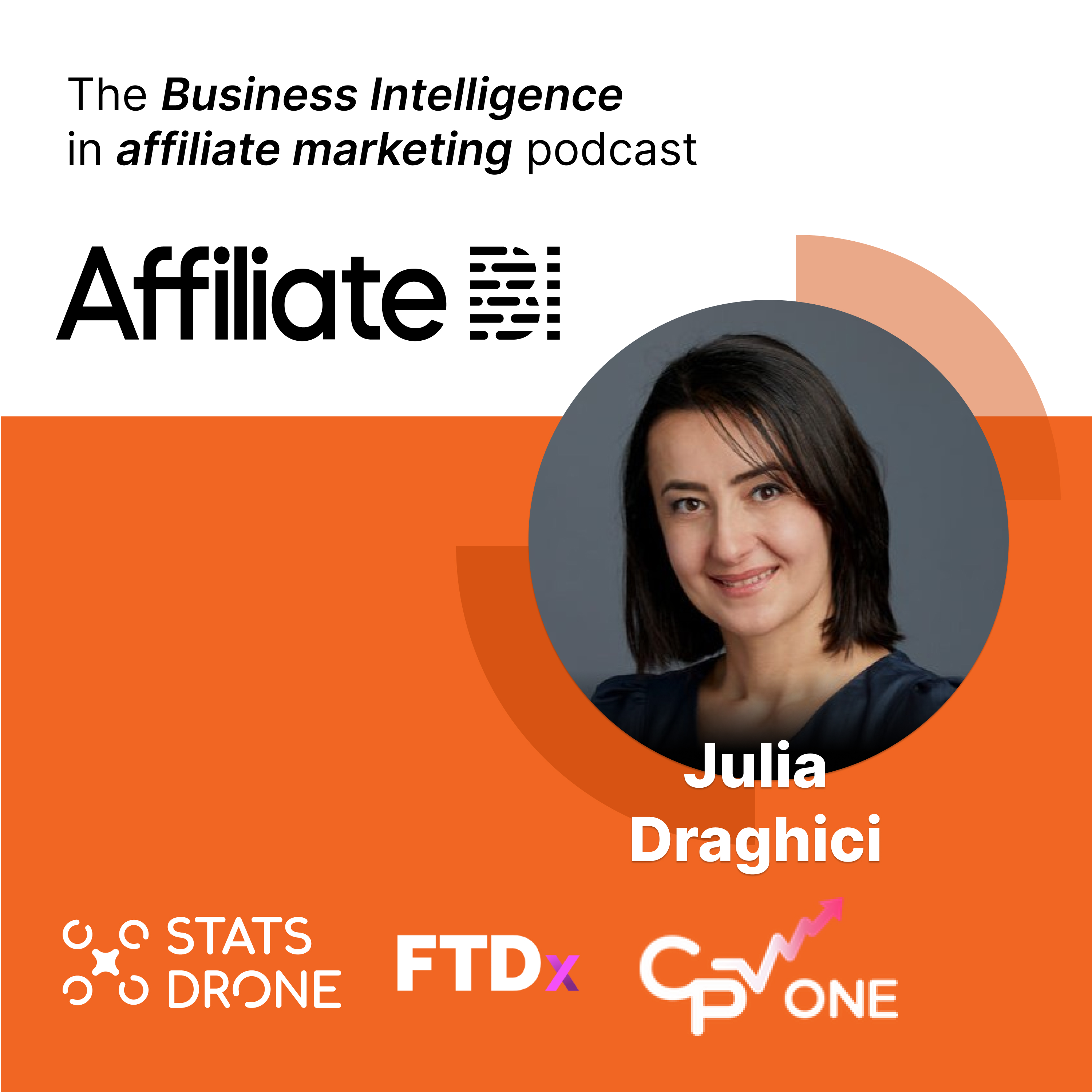
Affiliate data with Julia Draghici from CPV Lab & CPV ONE
Guest: Julia Draghici
About This Episode
Meet Julia Draghici, the co-founder of CPV Lab and CPV One that helps affiliates, media buyers and marketing agencies to track, manage, and optimize their marketing campaigns in one place with a very powerful ad-tracking platform.
I'm excited to share this recording of Julia because we have similar apps that technically are competitors but we operate in different industries. We are both SaaS companies working in affiliate marketing where she acknowledges that SaaS industry shares and affiliates are secretive with data sharing and insights. She thinks this is something that should change to improve affiliate marketing.
How to reach Julia Draghici
Full Transcript
Show: Revenue Optimization with StatsDrone
Episode: Affiliate data with Julia Draghici from CPV Lab & CPV ONE
Host: John Wright
Guest: Julia Draghici
Published: Tue, 29 Oct 2024 11:22:00 +0000
Duration: 37:23
Speaker labels are a two-speaker split from pauses (host vs guest). Timestamps are `[HH:MM:SS]` from the episode audio. Light ASR; names and brands may need a pass.
---
John Wright: I think there is a lot of secrecy in the affiliate space and in the SaaS world, everybody is doing everything to be there and explain every step of the way how they are doing it. But on the affiliate side, it's not like that. And so if something we could learn, probably it would be this, to share more and maybe if we share, we can get ideas from others and learn from them experience and we'll not have issues like, I don't know, problems by ourselves to solve them by ourselves. Maybe we will have help from others.
John Wright: I'm Joan Wright and you're listening to Affiliate BI, the business intelligence and affiliate marketing podcast brought to you by Staff Style. Welcome to the affiliate BI podcast. They were chatting with Yulia Dragic and she's the co-founder of CPV Lab and CPV One. They help affiliates, media buyers and marketing agencies to track, manage and optimize their marketing campaigns in one place as a very powerful ad tracking platform, something that's near and dear to my heart for what we do with our company. So Yulia, welcome to the show. Thank you. Thank you, Joan, for having me. I'm really excited to be here. Awesome.
John Wright: I want to get started into the story of how did you get into affiliate marketing and what led you down the path to say there's something missing in the market. I want to create a solution for it and start CPV Lab. Oh, okay. I came to affiliate marketing by chance, I would say. I studied economics and computer science and I worked with computers and software development teams and stuff like that. When I was in maternity leave, I didn't want to go back to my corporate job and it happened
John Wright: that in that same period, my partner, Radu, which is the other co-founder, he was left alone with the project. He started CPV Lab with some other marketers from US. They were running campaigns and Radu is a very good developer and they were having like spreadsheets with data. He said, oh, but let's do a program. I will do a quick program just to automate that. We cannot work like that. They saw the need on the markets like that. That's how it started actually from their need, having those spreadsheets and saying,
John Wright: I want to make things easier for us. Yeah. Of course, later on he discovered that he's not very good at marketing. He's better on focus on development. He's doing that now. Yeah. That's the unfortunate reality of us as SaaS companies. No one knows what they're doing until they try it. If you're good at solving problems, it's how do you communicate what you're solving. You probably spent as much time as I do on go-to-market, SaaS marketing, SaaS sales, SaaS everything. It's never ending. Yeah. Because as I said, I was working with product development on the business side, on the development side.
John Wright: Very early on in my career, I worked as a gap between the business and the development team to communicate and make sure they understand each other, like the language and everything. Then I said, when I came to the project, I said, what can be that difficult? I know how to manage teams. I know how to manage projects. Let's manage a business. Let's go full-time because that was the decision back then. We do this, but we will do it full-time all in and go business out of it. Yeah, of course, I had no experience in affiliate marketing, a product. I don't know. You make money by promoting other products. It was a very long process of learning.
John Wright: It's still a process of learning because I still feel that there are very specific things that I don't know yet. What I do like in this industry, affiliate marketing, it's very dynamic, adapts. Also there are so many young people that are just making it. When I go to this conference, I meet a 20-year-old guy saying, oh, I have my own business running and stuff like that. I'm like, oh my God, what did I do in my 20s? I look back and I say, oh, I was partying or something else. I admire them so much now and a little angry.
John Wright: Yeah. But at the same time, I'm not anywhere near my 20s. I'm in my 40s, but you could use that work experience to your advantage. So if you've been working on the tech side in anything, digital marketing, you really have built up skills that are the foundation of what you have today, which is when I think about going, okay, who are the players in the space that we operate in? I can't think of a lot of people that have our skill sets. You have to grow it. There's no other way. Yeah, exactly.
Julia Draghici: Actually, my initial contact remark was one of my initial jobs. We were doing software for marketing agency in the US. It's quite interesting to see when I look back now, how they were operating because we were doing the tracking part for them and they were doing mails, like direct mails. They were sending three mail to mail, some, I don't know, toys or, I don't know, a ball or a toy or something. We took the tag with a link or was saying, I don't know, my top five something slash your name, John.
Julia Draghici: And that person will enter on that URL and we were tracking that. And also they would get a video, say, hi, John, how are you doing? I know you have this concerns and stuff like that. And this was happening like quite a few years back. And I still think that personalization that was working then, I was impressed with me back then, it's still working now in our industry when personalization in marketing, it's still very powerful.
John Wright: You're touching on a topic that I don't think is talked about enough, which is personalization. It's like, how do we do that at scale? And I'm not sure if there's an easy answer, but that's actually a really cool example of how you took a tracking link and said, okay, we're going to make it dynamic for the user. And when they click on it, you're going to basically get all the activity. And that's actually amazing that you even said, okay, you're going to take it one step further and put a video behind it. So it's like, that's when I've heard of such an amazing campaign. Yeah, that was like more than 15 years ago, they were doing that. And I was like, oh my God, we are doing that. And we are doing the videos and those dynamic elements in the videos to load and
John Wright: to track them, of course. But that was, yeah, I was really impressed back then. It was contact with marketing side of the business.
John Wright: Would you say it would make a difference if that could have been a QR code or do you think maybe a link is better or it's just one of those depends things?
John Wright: I think back then they were not QR codes, but now I think with QR codes it's much easier because you don't have to type the URL in main states, maybe if you don't type it right, but yeah, with a QR code, it would be much easier. But on the other side, when you see the URL there, that is like URL slash John Wright, you are like curious. Oh, it's my name there. Maybe I want to check it out.
Julia Draghici: Yeah. That's, that's the first single touch of personalization is like right in the link. It's this is for me.
Julia Draghici: Yeah, exactly. What is there for me? Okay. So I want to jump into more of what your product does. So maybe we should start there and say, uh, tell us what CPV lab and CPV one does and what are the differences between the two? Yeah, sure. So we started with CPV lab. It's a self hosted tracking solution at tracking, or it helps performance marketers, as you said, media buyers, e-commerce marketing agencies to track that campaign, to test learning pages offers and have the data mainly in one place so you can optimize further based on the data because if you don't have data, like messy and you know that.
Julia Draghici: And the difference with CPV one is that we have CPV lab itself hosted. The user has to have posting and hosted on the server, which provide them with privacy. Nobody has access to the data and nobody can get the campaign, the winning campaigns and stuff like that. On the other side, CPV one it's in cloud. It's much easier from managed to manage for us as least as a company because all the releases and all the support is done much easier with the self hosted solution. We had quite some headaches and we still have sometimes because there are so many
Julia Draghici: hosting solutions and you have to know how to install them everywhere. And when you release some changes, they need to update them and they have issues and also finding the people to do all that stuff because you have to get technical people from the development to do all that stuff. When you are left behind, it's on the business side is much better on the cloud, but for the users, they, some of them that are more technical, they prefer still the self hosted solution. And we decided to separate them because the plan is at some point to have some more bigger differences on the cloud solution, something that we cannot do
Julia Draghici: through currently with the self hosted for, because we don't have that date.
John Wright: Now having the data, we could do some automation, more training or predictions or things like that, all based on the data.
Julia Draghici: So that's why we decided to separate them, separate them every on, even though the tracking solution, what they do, they interpret it mostly the same now. But as we grow, I think there will be much more differences. And that was the reason mainly why we separate them.
John Wright: Would you say that your tools could do something where like my personal opinion is like, any time I have to do anything with Google Tag Manager, I'd just say, okay, here's a headache. I got to set up all these tracking campaigns and very technically heavy. Would you say that this is, this could be like a replacement for a better attribution or just easier to handle with maybe better best practices?
Julia Draghici: Yeah, of course.
Julia Draghici: I think everything is much easier once you learn just one tool and you just apply that for every campaign that you are working with.
Julia Draghici: Of course, there is a learning curve for everything, but having all these integrations with so many app networks via server to server, and also with the affiliate networks, it makes things much more easier for you to have one link to rule them all, one place to have all the data. Because it makes sense. You are on campaigns on different networks and you are on offers from different affiliate networks and getting that information about conversions is important for you. Not log in all those platforms or have spreadsheets, God forbid.
John Wright: So it's important to have that data. You are in performance marketing at the end of the day. And having that data, it's what makes your life better than butter. Yeah, it's everything. So digging in a little bit further, what niches would you cover? Cause I've seen some of the different logos you have for the integration partners. I think it's, you integrate with a lot of different data tools, like I think Google ads, Facebook ads, and then like I saw a bunch of networks there.
Julia Draghici: Yeah. So on the ad network side, the system, our tracking, it's quite easy to customize. So we integrate of course, with the mainstream one, Facebook, TikTok, Google, and so on.
Julia Draghici: Also without the ad networks that are there, depending on the verticals, we don't have a specific niche. Every, our affiliate decide the niche they are working with. And we integrate with, so my thing, like we have more than 150 or something. Ad networks. And it's easy because if you have, if they provide the tokens and the post back URL, you can send back conversions to them because the flow, as you know, probably is that the track is in between. So is the ad network sending the traffic to a tracking link that you have from the tracker, and then you do the tracking for the visitor in the
Julia Draghici: tracker and send that visitor to the, or to the offer, depending if it's an affiliate or if it's an affiliate program to the offer. And then from there with the post back URL, with server to server, you get information about conversion back to the tracker because you want that information and of course how much, depending on the affiliate network, they can send you more information, not only about conversion, they can send you other information as well, which can help you optimizing.
John Wright: And then this flow could stop here or better yet you can continue and having the conversion push back to the ad network so they can optimize the traffic they're sending to you. Because what you are saying say, say, Oh, Hey, ad network, I'm, this traffic is converting. I want more like this. And so by sending those conversion back to the ad network, that's what you are saying them or telling them, and they will say, Oh, okay, our algorithm can be adapted and we send back more traffic like that. So that's how the full cycle, I would say, and the tracker is in between
Julia Draghici: helping with that, with the tracking of the traffic, with the traffic of the conversions and the connections in all of them.
John Wright: And also there is an interesting part with that. So some affiliate networks are asking information about sources. Like they want to know the source of the traffic. We had quite a few users coming to us with that and they have concern about that because they say, okay, why do they know what do they want to know about the sources if I send good traffic, if it's not bought traffic, why do they are interesting that?
John Wright: Yeah. So for the affiliate network is that they need stat. They need, I don't know information, but on the other side, the affiliate network knows the offers that are converting, right? They know which of them are more profitable and all, most of all of the affiliate networks have an internal media binding.
Julia Draghici: And of course the affiliate concern is legit because he said, okay, if I send them the source of the traffic, they will be able to understand
Julia Draghici: offer themselves. And so I do the testing and they run the offer. Right. And so the tracker is helping there because you can decide to not send the source of the traffic.
Julia Draghici: But of course that affiliate network will ask, oh, send us. And more and more affiliate networks are saying, okay, you should put on the offer a URL or parameter saying the source.
John Wright: Oh, name that. I don't know. This is, this mistrust is something that is happening in the industry. And on one side, you can understand the, the part of the affiliate, right? Because investing in testing, investing, find it the best source of traffic. And then goes there and why, what's happening? Maybe the affiliate manager will say, we tell another affiliate about this source of traffic and you are like in between say, okay, I understand. I don't know. You eat your phone at the end of the day. If you want to send that information or not. Yeah. That makes sense. It's a situation that it did mistrust.
John Wright: It's, that's a good example of why, you know, I don't blame affiliates for sharing it because we have some PPC affiliates where they're like, we can't see our customer's data, but even when it comes to building a dashboard where it's okay, in order to build the dashboard for customized, we have to see it. They're just like, no, they'd rather not have the dashboard because they're worried that we would see their secret sauce and then we'd actually copy it. So I don't blame them because when I see this, when I see that response a few times, I say, totally understand. But that actually, this all leads to my, one of my questions I wrote down, which is, do you think there should be a future where more affiliates and operators like
John Wright: on both sides of the fence should come in the middle and share data? So for example, the affiliate program in theory, they mostly know how they're getting their traffic from their affiliates. Like sometimes they can see it's from a website, it's from social media, but other times it's from like a PPC link and it's mass and same thing for the affiliate sites, like they don't always have a lot of data from their operators and going, Hey, like when's the last time an affiliate program has said, we have a better campaign that converts better, are they even testing it and I don't know.
John Wright: Yeah, they are feeling actually, they say that they are having media buying team to test the offers and your question to share more data. Of course, the data will always be useful. And at the end of the day, you want to have more conversions and that data will help the affiliate become better campaigns and have a better conversion, right? And of course it will be useful for the affiliate to send more information about that because we actually had some cases, I think it was with ClickBank or I don't know, when, so you send traffic that the user goes to the checkout, but then no conversions are happening.
John Wright: So they feel the checkout and it's like that gap between the checkout and the conversions happening. And when the affiliate network started sending information about the checkout for impressions and you could see, Oh, but so they feel the checkout. But so the problem was on the offer page because that's where the process was difficult and they couldn't convert. Oh, okay. So the problem is there and you can understand that the affiliate network as well to solve that problem with the brand probably, right?
Julia Draghici: And that's one example that comes now when the data is so important to come back from affiliate to the affiliate, because at the end of the day, if he gets more data, she will be able to optimize better. His pay don't perform. I think it's his interest to have better campaign. Yeah. A total side question, but do you see affiliates doing more of this where they test their own tracking links and go, okay, we're going to actually get a friend to buy a product or a service and see the actual conversion happens. Do you think there are enough affiliates that do this? And should every affiliate do something like this?
Julia Draghici: Test their affiliate link. Yeah. To make sure it works. And even if they're set up, setting up like post-backs, like they're like, okay, I want to know if the post-back is actually working properly when there's a registration, if there's a registration activity or more importantly, when there's a sale activity.
John Wright: I don't think they're doing such a such test so often. They are testing if the tracking link is working. They are doing that as I know from my own side. They are testing if it's sending to the offer, but they don't test actually. I don't, I didn't see so many testing. The conversion is actually happening and it come back.
Julia Draghici: Yeah. I think, no, I didn't see that happening so often. Because I know one company in the iGaming space that's doing testing, but I don't think they're doing testing for this reason. They're doing it more for the operator point of view for actual players. But I just think that maybe there's a weird opportunity here for how many affiliates are just like dealing with like hundreds of tracking links. And then they just send them out and they're like, they have to wait like months later before they look at reports and go, wait a minute, find me all of my zero click tracking links or campaigns when they should not be zero at all.
John Wright: Yeah, exactly. Yeah. I think there could be an opportunity there.
Julia Draghici: Okay. So we'll put that as a side note. Maybe that's something that we both have to deal with on our own and
John Wright: future solution.
Julia Draghici: Yeah. Imagine that a solution based on what we're doing as a solution for other people, it never ends, does it? Yeah. If there is a problem and we can find a solution to it, that's mainly what it means to be a founder and building something. Yes. Okay. I'm going to pivot on a similar question about tracking, but it's on attribution and it has to do with self attribution. I don't think a lot of affiliate programs and products and services have a lot of self attribution. And us as SaaS companies, I started adding self attribution on our site. So let's look at the example. We're doing this podcast. It's going to get sent out on Spotify and YouTube and blog posts.
Julia Draghici: And if people see you and see CPV lab, they might actually Google it. So the attribution is from this podcast, but the attribution that's going to be tracked is going to be Google. So do you think there needs to be more self attribution and how is, maybe this is a problem we can never solve. What do you think?
John Wright: I think it's a very difficult problem to solve because it's mostly awareness that is brought to a specific product. And then it's very hard to track that. You can have two up codes, maybe specified, scan this and go there or I don't know, specific links, as I mentioned, with, I don't know, with your name saying there, like this will redirect to that product and it's associated with me. But I think it's, it's hard to track this kind of, this kind of attribution when the marketing is happening or the activity is happening,
John Wright: like life, it's like you go to a conference, you ask a speaker there. You cannot track how many are coming after you are speaking there because it can be, I don't know, diverse as well as you said, after this call, after this interview, we can have people Google it or searching on, I don't know, comparison sites or whatever they do review site. And yeah, I find it difficult. Why step would be to do a link, a QR or something, but not everybody will click on that and so it's very hard to have a very 100%
John Wright: attribution in that sense. Yeah. Maybe it's something we never solve, but it's always an interesting discussion. I love learning about this on the B2B sales side, but I think the supplies to the B2C side.
Julia Draghici: Yeah. That's my personal take. I just think there's not enough even self attribution on the endpoint for a user to buy a product or service.
John Wright: I think it's a problem with attribution on the entire flow, but I don't think this kind of attribution can be 100% solved. We can solve like step by step and at the end of the day, say, okay, we have like approximately match. Yeah. Maybe the future of this is actually using AI where it's like, can we envision all the tracking links linking to a product or service on a website? Can we scan and scrape all the stuff that's happening on social media, both in brand mentions and maybe that's the future, but I'm not solving that.
Julia Draghici: Not yet.
John Wright: Either not yet or not all. So if you want to take that one and run with it, I'll let you do it. Thank you. Thank you. I would just take a note and think about it. Yeah. Okay. So we're both SaaS companies and my background is I've used to build affiliate sites for the last 10, 15 years. What would you say some of the things that you've learned as a SaaS founder that you would be able to translate or transfer to affiliate marketers?
Julia Draghici: Twist.
John Wright: I would say that I don't know if it's from my experience as a SaaS founder or backwards, but I say, I would say that testing, it's super important. Testing like everything from small changes to big changes. And as you said that you are building affiliate sites, I know, I probably, you probably know how important this testing all these things. And yeah, I think it's, I think I got it backwards because this is something that I learned from the affiliate more than I, I think we can apply from my experience as a founder to affiliate because they are testing a lot like
John Wright: headlines that rotate and multivariate testing that they are doing so they can just find that perfect landing page, perfect ad that will just get more conversions and they see that by doing a lot of testing. And this is something that I learned from them.
Julia Draghici: So thinking about your question, what they could learn from my experience as in SaaS as a SaaS founder, I think that helping each other would be more beneficial in this industry because I feel that people are more concerned about revenue and just like that. And I think that's what I think it's good for them. But I think it doesn't do bad to be like more sharing good and more partnerships and helping each other because if you share some things, okay, we don't want specific, but if you share some general things, it will
Julia Draghici: help like the entire industry at some point because maybe somebody has an idea and sharing that those ideas get something bigger. I think there is a lot of secrecy in the affiliate space and in the SaaS world, everybody's like doing everything to be there and explain every step of the way how they are doing it. But on the affiliate side, it's not like that. And so if something we could learn, probably it would be this, to share more and maybe if we share, we can get ideas from others and learn
Julia Draghici: from them experience and we'll not have issues like, I don't know, problems by ourselves to solve them by ourselves.
Julia Draghici: Maybe we will have help from others.
John Wright: I think in my comparison of being on both sides, it's like, I think the SaaS community is, they're more likely to build in public because I think SaaS is such a weird pace as an industry. Like SaaS went from being, okay, it's a thing to like, now it's all the craze that venture capital wants to put money into. So what I find personally interesting is I like building in public. My business partner and co-founder, he's maybe a little less comfortable with it, but I think affiliates don't do this enough and I actually think SaaS companies could do more of it. But I defend everyone. I say, you know what?
John Wright: It's not very comfortable to share what works with you when you've got competitors. I think for what we do, we're not direct competitors. We're technical indirect, but we're in such unique separate spaces that I don't really see it as competition, but the ones I have as direct competitors in the iGaming space, it's when do I share things like number of customers or average revenue or what are the most top three go-to-market channels? It's, I say that some of these things in podcasts, but I just don't think they listen to them all the time. So that's my hope. You don't know. You don't know? I don't know.
John Wright: Well, maybe they listen, but doesn't matter if they will do it, they will not do it like you do it. So when they don't have your experience, your networking and yeah, at the end of the day, all the channels are, they can find out the competition can find out what you're doing and we can just learn from each other and do it in our way. Because each one of us has some specific thing that is particular to our tool, to our, I don't know, way of seeing things. And yeah, I think building in public, you said it right. I think that missing from that field, but they, what could happen is, okay, you have some strategies, you have some companies that are working.
John Wright: One that you run them out in six months, you can share those experience. That is still useful because we can still learn and adapt to our niche, with our vertical, the product can be high gaming, neutral or whatever, but it can be adapted. We can learn from each other and we can do that only by sharing.
John Wright: I agree. But one thing I do think that is mostly true, especially in my experience in the SaaS space. And I also relate to this as people that do SEO consulting. It's the most successful SEO consultants. I noticed that almost all of them were on podcasts and they do video. And then because I'm a SaaS geek, it's, I follow a lot of people. Like I follow like you ran Hoffman, I follow Tom Hunt and I'm like, okay, I'm just consuming content. And Tom Hunt was pretty influential and said, look, the things that are interesting about podcasts is that it might not look like there's a lot of volume there, but it becomes a channel where people learn to trust you.
John Wright: And it's like video, I think is an extension of trust. Like I've been on podcasts where people have watched the show and they're like, I feel like I know you already. So I think the thing that is behind video is that video and other channels like LinkedIn is what other people, the rest of the world doesn't see. They don't see our DM activity.
Julia Draghici: Like that is something that it's very difficult to trace. I know there's tools technically that exists for in the sales pipeline, but yeah, that's something that people, they just don't see at all.
Julia Draghici: That's only for, for us.
John Wright: Yeah. I agree. I'm new to this networking and putting the face out there because I'm, I was more introvert and I tried to do train this muscle to go out there. And that's why we actually started like a post-card, I would say. It's just a few episodes where I try to, my idea was to invite like media buyers, people that have like hands-on experience with campaign, but it's very hard for me to find those people, only those people. I want also people with influence or like influence in the industry, the performance marketing, affiliate marketing. But my original idea was to have only media buyers, but it's very hard as
John Wright: I say, because they don't share that much information and they're not that public.
Julia Draghici: Find them. Even though we ask like in our customers, Oh, I don't want to show my face. And okay, but you could teach others so much, but yeah. I would, I would say just from my experience, we like covering a spectrum of guests that all relate to part of the industry and you have to remember that some of those media buyers might pay attention to other people. So if they have them on your show, then they're like, Oh, you've then captured their attention. So your ability to convert them in the future might actually increase.
John Wright: Yeah, I hope so. And your experience in saying, hearing you say that it's a good experience for you and a good channel helps me a lot, gives me confidence because as I said, I started that more for myself to get out of my comfort zone. I have some friends that do a podcast and they say they're introverts, but you never know it. They're like, they just went through it and they got so much experience that you're like, you think they're extroverts. So it's a muscle, right? Yeah, exactly. Someone told me that it's a muscle that you have to train. Okay. I'm starting training, Aina. Yeah.
John Wright: Like I'm a year and a half or I'm actually almost two years into this. So it's for me, I can do this all day long.
John Wright: Really? Wow. Yeah. And I was very uncomfortable doing it at the start, but I might be more extroverted, but still it's, it takes time.
John Wright: Okay. But I'm happy to help. So we'll try it in some DMs. So I'm going to, I'm going to pass you the last question, which I think you're more than capable of handling, which is what do you see of the future of affiliate marketing as it intersects with business intelligence?
John Wright: Oh, okay.
Julia Draghici: Data of course. It's, it's so important that you know that I know that. And I think everybody knows that by now and charge EBT show us that because AI was there long time before charge EBT. But when charge EBT came and you could see what it can do with so much data, because it got like data from the whole internet, you say, Oh my God, if I could have more data, I could do something. And so in performance marketing, as I mentioned, it's, um, so affiliate marketing, it's part of performance marketing and being performance means you need data to be performed.
Julia Draghici: It's logical actually, because you are paid on performance and you want to be as performance as you cannot do it. Like just by guessing it doesn't work like that. You'll just, you can guess one price, but not on the long run.
John Wright: And so by having as much data as you can, many more automations and that data could help you become a better marketer because at the end of the day, you have a tool, it provides you with data, but I don't think we are ready yet to have all the decisions left to machines.
John Wright: I don't think we are there yet. I don't, I still think you'd have to learn how to do it. Give you your touch and your input and decide, but yeah, we are getting step by step closer to where machine is doing more and more, and you have to come with other things. You have to come with more creativities with, I don't know, adapt. I actually talk with media buy-in in iGaming actually. And if he was doing something that a lot of media buying in iGaming are doing, like collecting running campaigns for regeneration, having an opt-in form and collecting emails and then doing all the selling via emails, email
John Wright: campaigns or running for specific gaming product or other product. And so he said that if he got more information, I don't know, knowing that person, I don't know, has kids or not or goes to the G or not, you can structure your message and make your message much more personalized. And by doing that, you get more conversion. And so that means you need data about that person, right? Not personal data, because that's not, yeah, but knowing statistics, it's more in the area of, I don't know, gym players or mothers or whatever.
John Wright: You could adapt your messaging. You could adapt everything, your learning pages. You could do more tests on that area, testing headlines in that area
John Wright: or images and so on. But yeah, at the end of the day, it's reasonable to data.
Julia Draghici: And I think we will see more and more of automations out there, more and more tools that will just happen to optimize the life for a few marketers. But yeah.
John Wright: Great answer. And that just gave me an idea, which is imagine you have someone coming through your funnel. So you're on the product or service side. And like you said, the more data you have, the more personalization you can, what can you do? You can do pop-up surveys inside your tool to ask them a few questions. And then as you keep doing these iterations, if you store this in your CRM, eventually your emails or your direct messages can be tailored. It's a...
Julia Draghici: Yeah. And with tours like Chagibidi that can help you with tone of voice, it doesn't matter if you don't speak that English, it can help you with tone of voice, which I don't know, I have this target. If you can give them more information about your target audience, you can tailor on the messaging much more specific to the problem they want. You want to solve for them or the product you want.
Julia Draghici: And so it would be like better targeting.
John Wright: Yeah. Beyond awesome. I think we could do this all day, but maybe we might have to have you on as a future guest. So I want to pass it back to you and say, Yulia, thank you for doing this. How can people get a hold of you? And yeah, I just want to pass the bat.
Julia Draghici: Thanks a lot for inviting me. It was awesome chatting with you. You can find me on LinkedIn. I'm Julia, the director of LinkedIn. You can find, I don't know, on our websites, bb.com. Yeah, I'm there. I'm not that much on Instagram or Facebook, but I'm there as well, but not that active. Only thing I'm more active, at least lately, I try to, as you said, putting a face there, within the network, it helps. And I noticed that it's very, a good learning experience for me. Yeah. More than happy to help and we'll include all those links in the show notes. Okay. Thanks a lot. Thanks a lot, John.
John Wright: Thank you for tuning in to the affiliate BI Podcasts. I'd like to take this time to ask for a small favor to leave a rating and reading wherever you listen to your podcast. That helps us expand our reach to rank higher in podcast directories and reach more listeners.